Supermarket Grocery of Future – Alibaba (in China)

By | July 9, 2026
china supermarket

Your Future Supermarket from New Retail
2026 Update – Alibaba’s “Supermarket of the Future” Becomes Instant Retail Infrastructure

When Wired UK first profiled Alibaba’s Freshippo (Hema) concept store in 2021, it looked like a glimpse of a distant future: ceiling‑mounted conveyor belts whisking shopping bags to the back of the store, facial recognition payments, mobile pickers fulfilling online orders within a tight radius, and blockchain‑backed supply chain visibility. Five years later, that future has quietly become a core part of China’s mainstream grocery landscape – and the battleground for a new wave of “instant retail” and AI‑driven shopping.

Today, Alibaba’s Freshippo/Hema ecosystem has grown far beyond the roughly 200 supermarkets referenced in the original article, with plans calling for more than 500 Freshippo supermarkets by the end of 2026 and an additional ~600 Chaohesuan NB community discount stores across hundreds of cities and counties. The conveyor‑belt‑enabled store‑as‑fulfilment‑center model hasn’t gone away; it has been scaled and paired with front‑end warehouses and dedicated instant‑commerce hubs so that 30‑minute and four‑hour delivery promises can be kept at city scale rather than as a one‑off flagship experiment.

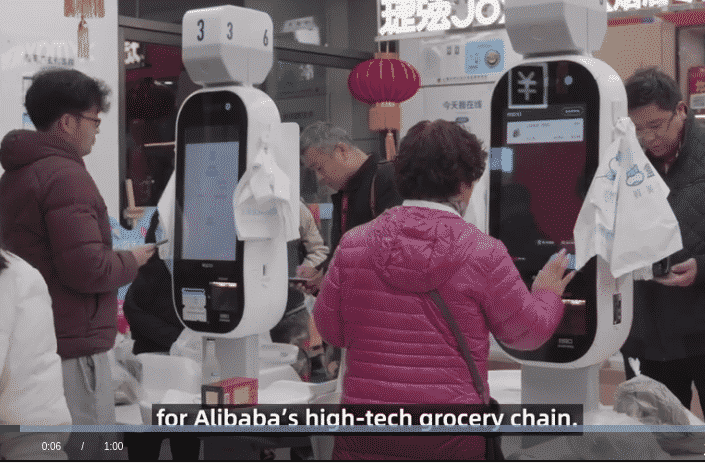
freshippo kiosk

freshippo kiosk

This growth sits inside a much larger competitive shift. Meituan and JD have launched their own tech‑heavy supermarket brands and discount formats – such as JD’s 7Fresh and Meituan’s Kuailehou and Xiaoxiang – combining upscale experiential grocery, community discount stores, and front‑end warehouses under a single instant‑retail umbrella. At the same time, traditional chains like Lotus, China Resources Vanguard, and RT‑Mart have closed hundreds of stores as foot traffic and margin pressure push them into a “shrink to survive” cycle. What looked like a cool one‑off pilot in 2021 is now one of several networked, data‑driven grocery platforms reshaping the entire sector.

The technology stack has also evolved. Freshippo still relies on tight delivery radii, in‑store pickers, and ceiling conveyors feeding delivery riders, but Alibaba’s logistics arm Cainiao is now building dedicated instant‑commerce warehouses for Tmall Supermarket in dozens of cities. These nodes act as micro‑fulfilment hubs that complement Freshippo stores, enabling a mix of 30‑minute local delivery and broader same‑day coverage for dry goods and packaged groceries. On the front end, the experience has become more cashier‑less and AI‑assisted, with richer data flowing into assortment decisions, dynamic pricing, and staff scheduling.

Perhaps the biggest change since the original “supermarket of the future” coverage is on the interface side. Back then, it was easy to imagine “Coming – AI assistant on your phone” as a futuristic bullet point. In 2026, Alibaba’s Qwen consumer AI app makes that assistant real: customers can chat with Qwen to order food and groceries, trigger payment via Alipay, and coordinate delivery from Freshippo stores and front‑end warehouses without leaving a conversational interface. Qwen’s orchestration features – handling tasks, calls, documents, and itineraries – hint at how grocery, payments, travel and everyday errands may converge into a single AI‑mediated channel.

For Western grocers and retailers, Alibaba’s supermarket of the future is no longer just an interesting case study in “New Retail.” It is a live blueprint for what happens when three pillars come together: instant‑fulfilment infrastructure (stores plus micro‑warehouses), AI front‑ends (assistant apps that manage shopping for the customer), and data‑driven physical formats (premium supermarkets and discount community stores tuned by real‑time data). As you read the original Wired description below, it’s worth mentally upgrading it from “prototype” to “operating system” for one of the world’s most contested grocery markets – and then asking how much of that operating system is starting to appear, in pieces, in your own markets.

Big SCO Self-Checkout picture in 2026

  • Most modern supermarkets and hypermarkets in major cities support some form of self‑service checkout: scan‑and‑pay via app, small kiosks, or camera‑based “smart” lanes.

  • Legacy chains and smaller grocers still run manned tills in parallel; self‑checkout is a convenience layer, not a full replacement.reddit

  • Early experiments with fully unattended “walk‑in, walk‑out” supermarkets (Alibaba, BingoBox, Zhima Credit pilots) proved technically viable but did not become the dominant grocery format, partly due to shrink and economics.

How it actually works in grocery stores

  • App‑based and QR membership flows: shoppers frequently scan a store or membership QR code (Hema, Sam’s Club China) and then check out at machines or via mobile, paying with Alipay/WeChat Pay.reddit

  • Self‑checkout kiosks: chains like Metro and others deploy Telpo‑type kiosks with barcode scanning and multiple payment options, including EFT, QR and facial recognition.kioskmarketplace

  • AI self‑checkout: newer formats such as Meituan’s Xiaoxiang supermarkets use computer‑vision terminals that watch the transaction in real time to reduce shrink and speed up checkout, positioned as a “24/7 digital cashier.”telpo.com

  • Cashierless/mini stores: smaller self‑service grocery and convenience concepts let customers scan items themselves, pay in‑app, and walk out, often with no staffed register at all.youtube

Facial recognition and “smile‑to‑pay”

  • Face‑based payment is now a mainstream add‑on at many checkouts; shoppers can select “pay with face recognition” on a tablet‑like device, look at the camera, and confirm the transaction.chowhound

  • Adoption is significant: estimates put usage around one‑third of the population in 2021 with steady growth since, helped by Alipay’s “smile‑to‑pay” rollouts and grocery chains integrating the option alongside mobile wallets.chowhound

  • User sentiment is mixed: many find the flow faster and more convenient than traditional self‑checkout, but some describe it as “too simple” or unsettling from a privacy perspective.chowhound

Operational and strategic implications

  • For operators, pure SCO lanes are increasingly seen as a cost‑savings baseline; the innovation focus is on AI‑aided checkout (vision, loss prevention) and integration with instant‑commerce/delivery networks.telpo.com+1

  • Some early fully automated grocery pilots (e.g., JD’s unmanned stores) have been shut down or scaled back, suggesting that completely cashier‑free supermarkets are still niche compared with hybrid models.reddit

  • The emerging template in 2026 looks like: staffed lanes plus kiosks plus app/face‑based pay, all tied to membership and delivery, rather than a Western‑style “either manned or SCO” dichotomy.


2021 Original

From Wired UK Jun 2021

Shopping bag conveyer belts, personalised food recommendations and facial recognition payments aren’t so futuristic anymore

In Brief:

  • 200 Freshippo supermarkets
  • Precise products scanned, go to conveyor belt to back, and then are delivered
  • Pay for it all via facial recognition
  • Blockchain technology helps trace thru supply chain
  • Robotic shopping carts controlled by wristband
  • Display, ordering and shipping all under one roof
  • Each employee averages 120 orders per day
  • Coming — AI assistant on your phone
  • Lockdown doubled online orders
  • Which leaves traditional grocers with strategic decisions to make. How can they fulfill online orders while staying profitable? And how can they make better use of their sprawling bricks and mortar estates?

Excerpt

The sight of shopping bags being whipped above your head on conveyor belts is the first clue that Freshippo isn’t your average supermarket.

Pickers in pale blue polo shirts scour shelves, scanning barcodes with smartphones to locate the precise brand of apples, sesame oil or spice mix that match online orders. Once found, items are dropped into a bag, hooked onto the automated conveyor system and whisked up and off to the back of the shop, where delivery bikes await.

There are now more than 200 Freshippo supermarkets like this up and running in China, all serving as both ultra-high-tech supermarkets and state-of-the-art fulfillment centres (within a three kilometre radius, all online orders arrive within 30 minutes of when a shopper clicks “buy”). They are all owned and operated by e-commerce behemoth Alibaba as part of its plan to take the lead on what it calls “New Retail”. And as supermarkets in the west emerge from the effects of the pandemic, Freshippo may well provide a blueprint for how they’ll reimagine their own stores too.

Video

Author: Retail Systems

Craig Allen Keefner is an influential figure in the self-service technology industry, best known for his leadership in kiosks, digital signage, and retail automation. Based in Denver, Colorado, Keefner has managed the Kiosk Industry Group (Kiosk Manufacturer Association) since 2014, supporting self-service professionals and overseeing projects in kiosks, point-of-sale systems, thin client technology, and related fields.​ Over his career, Keefner has served in various executive and managerial roles—including as owner and CEO of pioneering kiosk and retail tech companies, as well as managing key industry websites such as comp.infosystems.kiosks, kiosks.org, kioskindustry.org and thinclient.org. His experience also includes significant contributions to the deployment and advancement of interactive technology in healthcare, retail, and smart cities.​ Often recognized as “Mr. Kiosk,” he is noted for his expertise, industry advocacy, and innovation in digital self-service solutions