
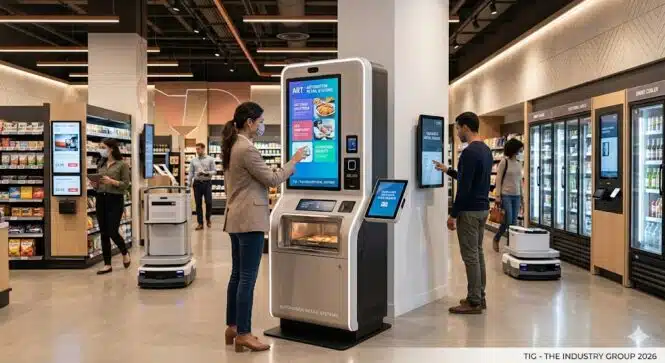
From Edge Hardware to Agentic Commerce — The 2026 Retail Automation Stack: The Definitive Guide
Executive Summary In 2026, retail automation has moved beyond the “trial and error” phase. As labor costs rise and consumer expectations for frictionless service peak, the industry has converged on a hybrid model of Human + AI + Automation. From the deployment of mass-scale Digital Shelf Labels (DSL) to the “Agentic Commerce” revolution, this guide breaks down the multi-layered technology stack defining modern retail.
1. Defining the 2026 Automation Stack
The modern retail environment is no longer a collection of isolated machines. It is a cohesive “stack” of five integrated layers:
-
The Edge Layer: Physical touchpoints including self-checkout (SCO), smart vending, and computer vision-enabled “grab-and-go” portals.
-
The Operations Layer: Back-of-house and shelf-edge tech like DSL, automated inventory planograms, and robotic fulfillment.
-
The Intelligence Layer: AI “Agents” that don’t just answer questions but sync carts and assist in complex product discovery.
-
The Commerce Layer: The payment and loyalty engine, often built on Android POS ecosystems and biometric contactless entry.
-
The Data Layer: The “Retail Media” engine that uses first-party data to personalize the experience in real-time.
2. The Robotic Food Revolution: 24/7 Autonomous Dining
One of the most significant shifts in 2026 is the transition from “snacks” to “services.” Temperature-controlled robotic kiosks are redefining the hospitality landscape.
-
Hot Food Automation: Partnerships like Sodexo and ART are deploying thousands of robotic kiosks, bringing state-of-the-art dining to facilities where 24/7 staffing isn’t feasible.
-
Brand Accessibility: High-demand brands (e.g., Chick-Fil-A) are now accessible via automated vending in hospitals and transit hubs, maintaining strict temperature and quality standards.
-
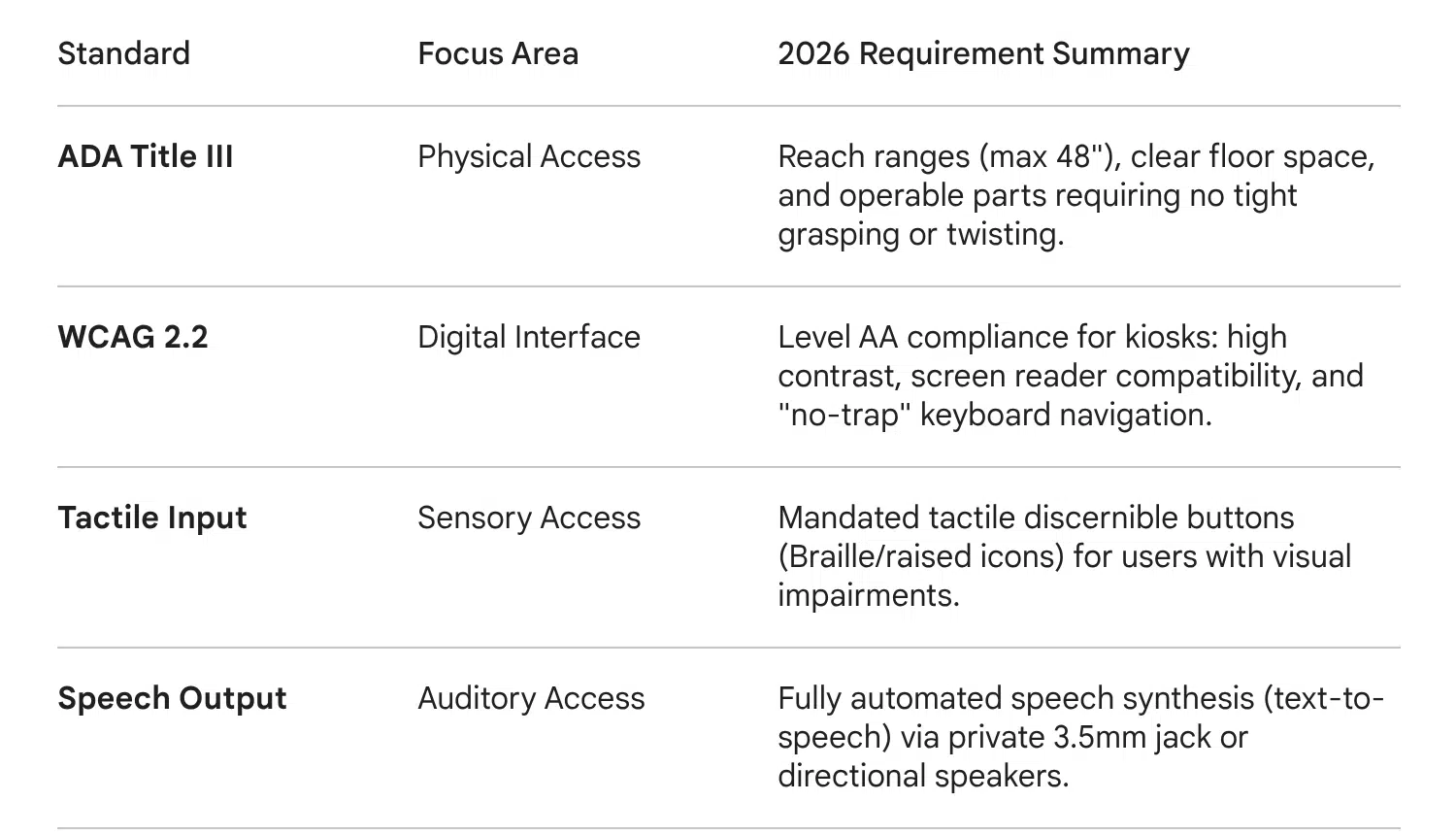
The ADA Factor: Modern machines, such as those from Crave Robotics, now feature fully ADA-compliant touchscreens and dispensing heights, ensuring inclusivity is built-in, not bolted on.
3. Self-Checkout 2.0: The Optimization Phase
Rumors of the “death of self-checkout” have been greatly exaggerated. Instead, we are seeing a disciplined rebalance:
-
Shrink Control: To combat the $100B annual theft problem, retailers are implementing computer vision “lane-watching” and item limits (10–15 items) to manage friction versus security.
-
Accessibility Mandates: Nationwide rollouts of accessible self-checkout (including audio, tactile, and braille) are now the baseline expectation for Tier-1 retailers like Target.
-
Service-Driven Revenue: With hardware becoming commoditized, 72% of the market value now resides in the integration, support, and lifecycle services of these units.
4. Digital Shelf Labels (DSL): The New Backbone
The massive rollout of Digital Shelf Labels (notably Walmart’s 5,200-store deployment) is the quietest but most impactful change in the industry.
-
Real-Time Agility: Centralized control allows for instant pricing updates across thousands of stores, eliminating manual labor.
-
Dynamic Foundation: DSL is the prerequisite for dynamic pricing and “at-the-edge” retail media, turning the shelf-edge into a digital billboard.
5. Compliance, Standards, and Regulatory Guidelines
For OEMs and SMBs, navigating the “alphabet soup” of standards is the difference between a successful deployment and a legal liability.
-
Accessibility: ADA Standards and local regulatory pushback on staffing ratios.
-
Data & Security: PCI for payments, HIPAA for medical-grade kiosks, and UL/CE for hardware safety.
-
Technical Interoperability: OPOS, JPOS, and MPOS remain critical for POS ecosystem integration.
6. The Bottom Line: Craig’s 2026 Signal
If you strip out the hype, the signal is clear: Self-service isn’t going away; it’s getting disciplined. AI is shifting “upstream” into discovery and personalization, while the infrastructure—the DSL, the edge compute, and the services—is where the real investment is flowing.
The next 12–24 months will be decided by who successfully controls shrink vs. friction and who owns the customer interface layer.
Frequently Asked Questions (FAQ)
Q: Is robotic food vending actually ADA compliant? A: Yes, 2026-gen kiosks from leaders like Crave and Kiosoft incorporate adjustable UI heights and tactile interfaces to meet strict ADA standards.
Q: What is “Agentic Commerce”? A: It is the shift from “chatbots” to “AI agents” that can actually sync with your cart, remember preferences, and assist in the transaction flow rather than just providing info.
Q: How much does “shrink” impact automated retail? A: Industry estimates cite ~$100B annually in retail loss, which is driving the shift toward computer vision and AI-assisted checkout lanes.
Compliance & ADA Standards: The 2026 Framework
Navigating the regulatory landscape is the most critical step in deploying self-service technology. Below are the three primary areas of focus for 2026: Accessibility, Data Security, and Hardware Safety.
Table 1: Physical & Digital Accessibility (ADA/Section 508)
Focus: Ensuring inclusive access for all users, regardless of physical or sensory ability.
accessibility
Table 2: Data Security & Transaction Integrity
Focus: Protecting consumer data and ensuring financial “trust” layers.
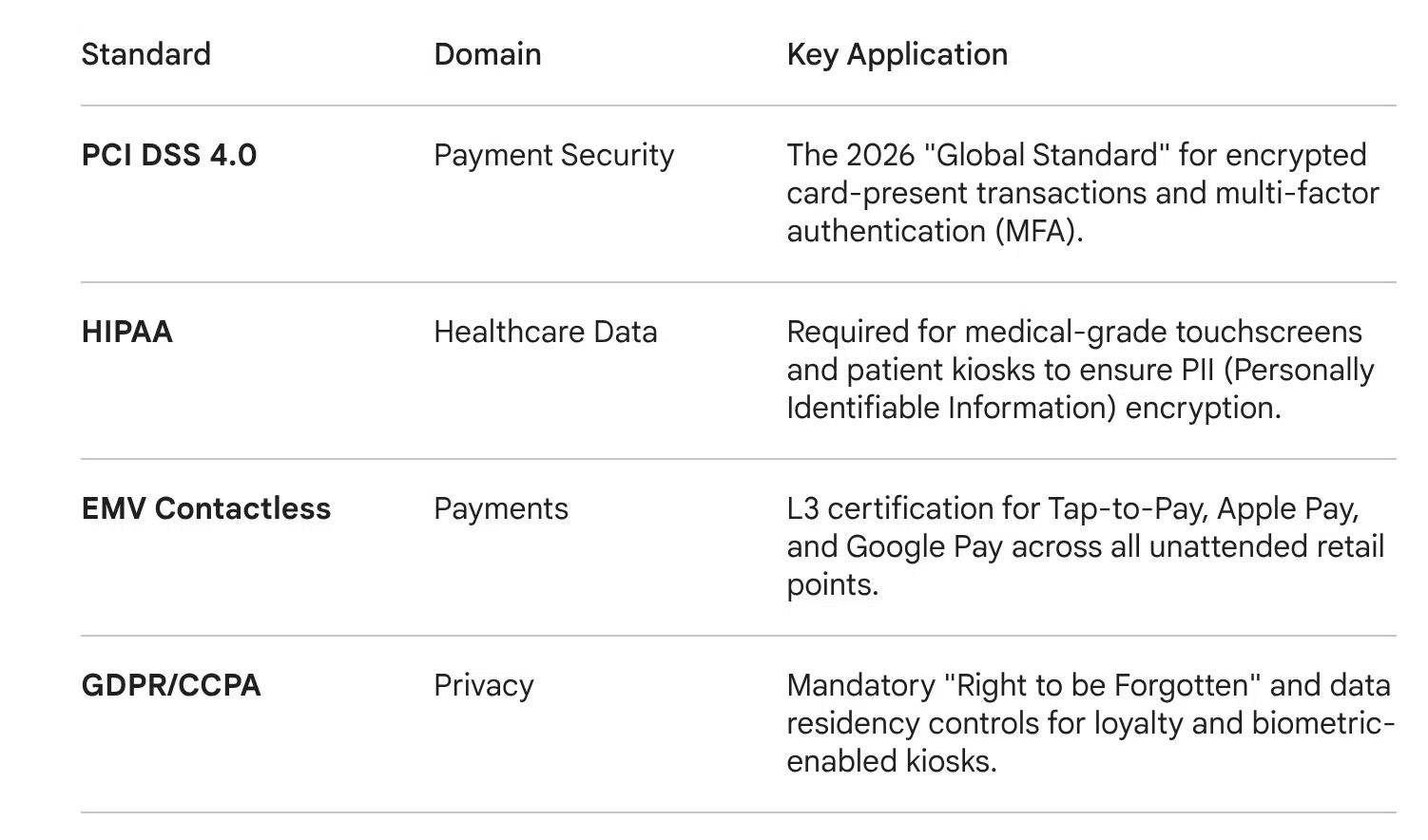
Table 2: Data Security & Transaction Integrity
Table 3: Hardware Reliability & Integration Standards
Focus: Safety, electrical compliance, and software interoperability.
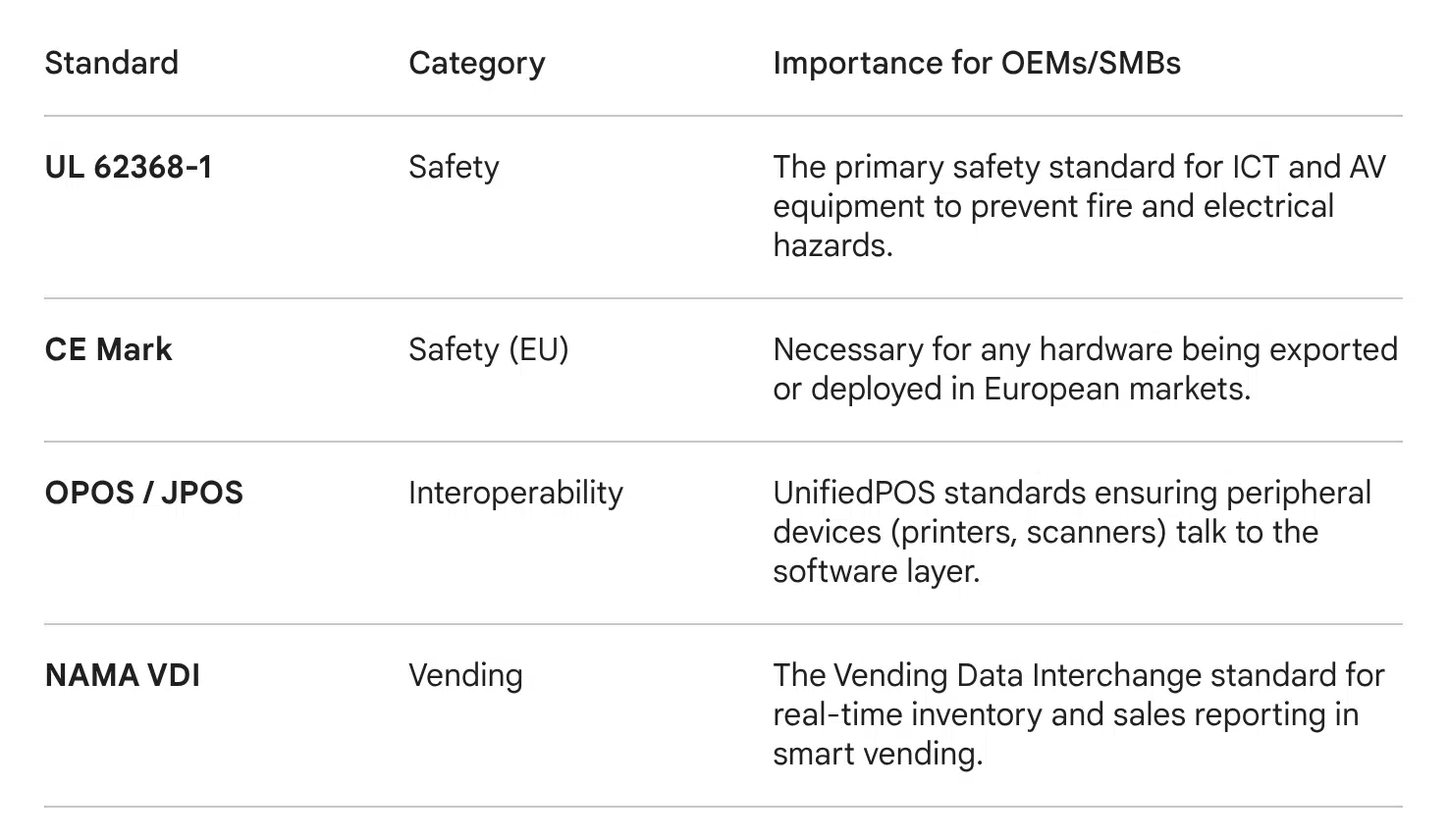
Table 3: Hardware Reliability & Integration Standards
TIG Expert Insight: Why Standards are the New “Barrier to Entry”
In the previous decade, hardware reliability was the primary concern for retail automation. In 2026, the battlefield has shifted to Regulatory Compliance and Data Integrity. The transition from PCI DSS 3.2 to Version 4.0 isn’t just a technical patch; it represents a fundamental shift in how we handle edge-computing threats in unattended environments.
We are seeing a “collision of worlds” where medical-grade security (HIPAA) is now required in retail settings—think automated pharmacy kiosks or biometric loyalty programs—while ADA Title III enforcement is moving from “best effort” to “mandatory audit.” For OEMs and SMBs, these tables aren’t just checklists; they are the framework for de-risking your investment. If your kiosk isn’t accessible or your data layer isn’t encrypted to 2026 standards, you aren’t just facing a fine—you’re facing a total exclusion from the Tier-1 retail ecosystem.
End of Content