

Explanation for Why Fiserv Has Gone South
Thanks to Reforming Retail — We recommend subscription — All of us in payments noticed Fiserv falling off cliff last week.
Fiserv’s stock price collapsed last week due to an unexpected earnings miss, sharp guidance cuts for both revenue and profit, and a major leadership shake-up, all of which shocked investors and triggered a historic sell-off.
Key Causes of the Collapse
-
Fiserv missed earnings estimates for Q3 2025, reporting much lower profits and revenue than analysts had projected.
-
The company dramatically slashed its forecast for full-year organic revenue growth from 10% down to just 3.5–4%, and also reduced its earnings outlook substantially.
-
Management cited that previous guidance was based on “overly optimistic growth assumptions” that proved unachievable after a rigorous internal review.
-
Fiserv announced the departure of its Chief Financial Officer, a shake-up in the board, and new executive leadership as part of its turnaround efforts.
-
These changes were further compounded by a securities class action lawsuit alleging the company misled investors in prior months.
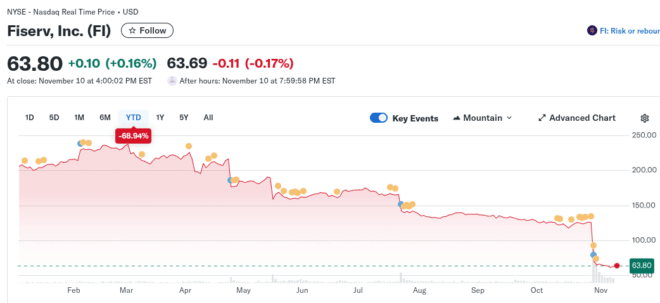
fiserv collapse
Thankfully we have Jordan Thaeler to help us understand the underpinnings..
We’re Confused How The Market Is Confused about Fiserv
To discuss what’s happened to Fiserv, and what it needs to do to succeed, we need to chunk this article into digestible portions.
Bank Channel
Fiserv has traditionally partnered with thousands of banks. If the merchant needed a POS these banks would refer Clover, Fiserv’s lightweight POS offering.
This model has started breaking.
Hard.
First, Fiserv’s large bank partners are coming undone.
Fiserv and Bank of America split ways.
And banks are an old way for merchants to get banking services, frankly.
You know who merchants are turning to for banking services instead?
Their software.
Not only is their software dominating the acquiring, but in doing so they’re earning the right to the rest of the finance stack.
Lending.
Payroll.
Issuing.
Payables.
Receivables.
Most of this is predicated on 1) having access to the merchant’s financials, and 2) having first claim to the funds if the merchant defaults.
If you’ve won the acquiring you get both.
To add insult to injury, neobanks are popping up everywhere.
Neobank CAGR is nearly 50% through 2032 and Chime opened more US checking accounts than any other bank in Q3 2025.
Businesses will start to see real use cases for stablecoins in B2B settings, further eroding the staying power of conventional banks who view stablecoins as the devil.
Where do you think these modern merchants will get their payments?
From some software partnered with the Neobank.
Maybe it’s Clover, but more likely it’s not.
ISO Channel
While banks represent some distribution directly, the bulk of merchants sign up through sales channels of the bank.
These entities, called independent sales offices (ISOs), have been beat to shit over the past decade as softwares embed payments.
This has left ISOs and agents on the outside looking in.
Roughly 25% of US payments volume comes from software today, and it’s going to reach 70% by 2030 (per Bain & Co.).
These merchants will get holed out as their softwares saturate their market and the software needs to show growth through rate increases, but in the meantime, ISOs are desperate to sell something.
Anything.
Sure, some of them may never be relevant again, as they have to learn software to be competitive in today’s market.
But for many of them, the answer isn’t selling Clover.
It’s Square.
Or SpotOn.
Or a software company that invests tens of millions (or more) annually into R&D to make a really f*cking good piece of software.
Clover was the only real bright spot for Fiserv over the past few years, buoying growth in a business that was propped up by inorganic acquisitions.
But Fiserv doesn’t invest enough in R&D to both digest their acquisitions nor churn out a competitive POS.
No payments companies do.
It’s simply a cultural problem in conventional payments.
They’ve been trained that engineering is for suckers.
And they were right up until about 2005.
See, the software engineers would be busy slaving to build and support products that payment bros would ride to make the lion’s share of the revenue.
Here software, we’ll pay you…. 10% of “margin” to introduce us to all your customers.
The software company thought this was awesome because they didn’t now how much money the payment bros were earining.
Mercury Payments started to reveal the true numbers when they more aggressively partnered with softwares and their dealer channels
That’s when the softwares said, “Wow, we’re doing all the work and getting HOW much? F*ck that: time to own it ourselves.”
Fiserv needs to give their ISOs something to compete.
Beef up the investment in Clover, and allow your ISOs to sell into software you don’t own.
Clover struck a partnership with Rectangle Health to enable Clover ISOs in the medical industries, but Rectangle is in ~40K locations.
There are something like 12 million US businesses.
Why did it take Fiserv so long to partner with Rectangle, who’s been around for 30 years, and why isn’t Fiserv aggressively finding other ways to make their ISOs relevant?

Market Reality
At some point you saturate a market.
The story then turns from growth company to stable, dividend company.
Fiserv found itself in the latter category, viewed as a dependable, single-digit grower.
Turns out that even that single-digit growth was fueled by inorganic acquisitions and getting-close-to-fraud polishing of the numbers.
Why?
Because there’s no real growth in brick and mortar, the segment of the market where Fiserv competes with traditional legacy acquiriers.

By and large the bigger, legacy acquirers (think Nuvei, Global Payments, WorldPay, Shaft4) just trade market share among each other.
They buy competing ISOs, raise fees, and hope enough merchants glance over their statements to avoid churning out (newsflash: merchants are clueless about pretty much everything in life).
So to be a coveted rule-of-40 company you better be really profitable.
But here’s the problem for Fiserv.
Adyen and Stripe – modern competitors to Fiserv – are growing 20% and an estimated 30% respectively.
How come?
The reason is so hilariously simple it’s amazing that they haven’t figured this out.
The first obvious answer for Fiserv’s growth quandry is that Stripe and Adyen are more firmly pegged to ecommerce.
Hell, Stripe’s motto is to increase the GDP of the internet.
Stripes card present capabilities leave much to be desired, and we’ve never heard raving reviews about Stripe’s BBPOS hardware solutions.
Adyen has made bigger moves into card present by virtue of signing some mega international retailers that have storefronts.
One might also think the newer processors win by having more geographic coverage.
Fiserv processes payments in over 100 countries, just like Adyen.
Stripe? 46.
So why does Stripe keep beating the pants off Fiserv and other legacy processor?
It’s the developer experience, stupid.
Stripe and Adyen have built platforms focused on developers.
Today, Stripe is quite bloated, but a few years ago a software company could get up and running on Stripe in about an hour of work.
That’s it.
You know how long it takes to integrate to Fiserv, or any of the legacy processors?
Months.
No, scratch that: quarters.
So long, in fact, that even if a legacy processor manages to convince a software to choose them for payments, many software companies abandon ship as they stroke out trying to read the API documentation.
We’ve coded to Fiserv’s Cardpointe gateway.
Total nightmare.
API docs aren’t accurate.
Camelcase matters despite the complete disregard for avoiding objects with the same names.
No wonder software developers leave.
A large processor shared that 90% of their contracted softwares miss their go-live dates.
Well yea, when it ends up taking 6+ months to integrate it’s impossible to predict a timeline from the outset.
We’ve looked at the APIs for nearly every major legacy processor.
There are three core problems.
1. Fragmented APIs with shitty documentation.
This means it takes developers months to even make sense of what to do. Go look at Stripe’s documentation by comparison. Very, very easy to spend 20 minutes reading, and then you can start to code.
2. Feature gaps.
While Stripe is bloated, it offers a ton of features in one place. Looking through documentation from legacy processors a developer starts thinking to themselves, “Oh man, I’m going to need to add custom code or middleware to make this work.”
That might not even be true, but the processors do such a terrible job documenting their capabilities that it scares off engineers.
3. Lack of self-serve tooling.
So many legacy processors lack engineering basics, like sandboxes, test cards, or webhook simulators. This prevents engineers from trying things out and making sense of the terrible API documentation.
Why are you putting these things behind a login or manual approval?
This is the current state of thinking from the legacy payments brains:
You know what the market needs is a payfac as a service solution! That’s why we keep losing to Stripe and Adyen: PAYFAC.
No.
These payfac as a service offerings don’t use product led growth: they sell to softwares the same way that the losing, legacy processors do.
Why do something that doesn’t work?
That’s now how engineers think.
In fact, softwares really only ever consider leaving Stripe or Adyen once a software has been around payments long enough and they recognize that they’re getting screwed.
Whether it’s Stripe charging 5% effective rates (or higher) for adding basic features, or a legacy processor pummeling you with nonsense fees, softwares struggle to understand how something that’s perfectly indexed to inflation has a reason to keep increasing prices.
The challenge is that processors know the game better than software companies and use all their tricks to keep the software hostage (i.e. card tokens).
The number of softwares we know that like the Stripe developer experience but detest the rates is basically 1/1.
This is the market telling you that if Fiserv and other legacy processors actually got their shit together they could and would board material new volume from software companies.
The solution?
Fiserv should offer a Stripe-like developer experience on top of a vault.
Maximize for speed (and therefore ease) of onboarding and prove legitimacy by allowing the software to move if Fiserv screws up.
This would 1) drive more inbound, 2) allow Fiserv to actually keep deals in the funnel, and 3) finally result in organic growth.
It’s such an obvious thing we have no idea why Fiserv doesn’t do it.
Well, we do know why Fiserv hasn’t done it: people at big co’s don’t do the bare minimum to avoid getting fired.
Given their stock is in the shitter, maybe they should, we don’t know, do something?
TSG, Fiserv Integrated Payments Report So Ironic It’s Alarming
This is NOT an indictment of TSG, who produces solid content.
This is about the total lack of self-awareness the payments industry has of itself.
Legacy acquirers have no idea how or why Stripe and Adyen kick the crap out of them then a report like this comes out, shows exactly why, and the legacy idiots are somehow still baffled.
Worse, they think they’ve solved the problems.
Dear Lord.
The first rule of any problem solving is to admit you have a problem, as Steve Blank pointed out.

We have never seen a piece of material scream so loudly at the industry’s problems yet fall so flatly on deaf ears.
Here’s the report we’re referencing
We’ll go through the relevant pages to show you what we’re talking about.
The intent of the report is to show how 150 software companies (ISV) think about embedding payments.
The first page that gets into relevant content is what matters when choosing a payments partner.
Guess what’s number one?

Hmm, if only someone might have told the legacy processors, like Fiserv in particular, why they’re playing 80th fiddle to Stripe…
IT’S THE DEVELOPER EXPERIENCE, STUPID.
The other six reasons on this page aren’t event relevant if you APIs are so shit the ISV won’t integrate with you to begin with.
But to add insult to injury, the SAME pain point shows right back up, masked under a different heading.

Think about how low this bar is.
Honestly.
All the legacy acquirers would need to do is hire a team of people and spend 6 months unf*cking their ISV onboarding process.
But, you know, that sounds like R&D, and payments bros can’t invest in that.
Moving on.
ISVs rate their current payment partners terrible: an NPS of -8.
You mean to tell us lying payments bros with nonexistent support and shit for APIs aren’t a software company’s dream?
Say it ain’t so!
And this is hilarious: look at how many times the developer experience – or the PTSD-inducing torture “experience” – is cited as a critical metric for software companies.

We’d also like to note that ISVs want portability.
Why?
Because they’re tired of getting f*cked over.
It’s like we told Fiserv in a prior article: build a great developer experience ON TOP OF a vault so the ISV can move.
If you provide good support, features, and economics, then the ISV won’t ever have to leave.
TSG summarizes the issues by making the developer experience front and center on the following page discussing trends.

And to really drive it home, let’s read the final page of the report before the fluffy self-promotion:

Now for the irony.
On the very next page Fiserv stands up and has the balls to tell us that they have “developer-friendly integration tools”.

Can you smoke more crack?
They are so. far. removed from reality.
You literally just funded an entire report telling you what your problems are and then you close the report by stating that you have none of these problems?
Okay, so why is Stripe growing 30% ORGANICALLY and you’re not?
Maybe their “Developer-friendly integration tools and sandbox environments” are ACTUALLY developer-friendly and not lip service?


