
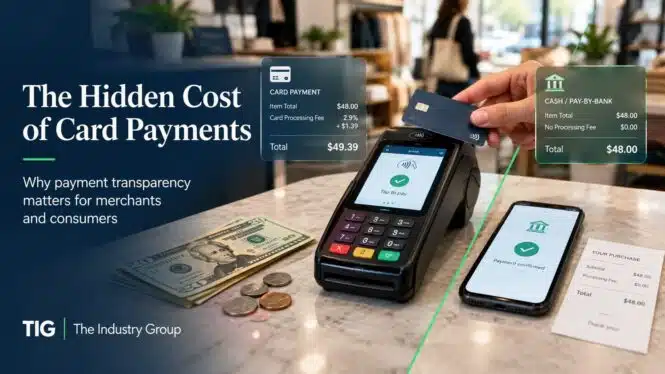
Provocative article by Jordan Thaeler is a deliberately provocative argument that the U.S. card-payments market is structurally broken: Visa and Mastercard, together with issuing banks and payment intermediaries, can keep extracting rising merchant fees because merchants lack meaningful negotiating power and practical alternatives. Its proposed remedy is not a permanent 10% card surcharge, but an intentionally conspicuous 10% cash discount designed to make consumers see the otherwise hidden cost of card acceptance and force demand for cheaper bank-to-bank payment rails.
For our world of self-service, the best practical path is probably not “return to cash.” It is make tender cost visible, preserve accessibility and choice, and create a frictionless lower-cost digital alternative. Consumers will not abandon card rewards merely because merchants ask them to; they may do so when the alternative is visibly cheaper, equally convenient, trusted, and works reliably at the kiosk or unattended point of sale.
Merchants should disclose payment-choice economics clearly, but should not pretend that cash is costless or that every card transaction carries a 10% expense. The policy objective should be transparent, lawful, tender-neutral pricing that lets customers see a reasonable cost difference and gives merchants a viable route to lower-cost payment methods.
That could mean:
- A transparent cash or ACH/pay-by-bank discount that reflects the merchant’s documented, all-in tender-cost difference.
- Clear signage before checkout, not an unpleasant surprise after the purchase decision.
- A modest incentive for debit or pay-by-bank instead of a penalty-like card fee.
- A payment screen that makes choices intelligible: “Credit: $X; debit: $Y; pay by bank: $Z; cash: $Z.”
- Merchant collectives or industry associations advocating for lower all-in acceptance costs, not just lower interchange.
- Investment in pay-by-bank experiences that match cards on speed, refunds, consumer protections, loyalty, and credit access.
Article Repost from Reforming Retail
You know how long retailers have been engaged in a class action against the duopoloists Visa and Mastercard?
20 years.
And you know what the initial ruling was?
A one-sided pile of horsesh*t that guaranteed we’d be in exactly the same spot in another 20 years.
- Visa and Mastercard will keep increasing revenues (but really profits) through fees so long as they are not called interchange
- Visa and Mastercard won’t be forced to compete as both card brands must be treated the same by merchants
- Surcharging – the only expedient way for a merchant to pass along absurd payment costs – will be arbitrarily capped by Visa and Mastercard
So guess what?
Society is going to find itself in the. same. damn. position 20 years from now, only the cost of payments will be 10% instead of 3%.
You know what we say?
Burn the whole thing down.
Merchants are unfairly subsidizing the costs of issuing banks’ consumer rewards programs.
Why is this the merchant’s problem?
So they can maintain the pleasure of losing half their margins to the payments ecosystem?
This is classic payments: create leverage on merchants and then hold them hostage indefinitely.
Here’s what merchants should do to break free.
Add 10% cash discount to everything.

Why 10%?
For one it would nominally cover the costs of consumers moving to cash (which they won’t for small transaction sizes).
But moreover it forces consumers to confront the cost of using their credit cards.
The problem with merchants raising their prices in response to card fees is that the consumer doesn’t see how much their credit card directly costs the business.
When a 10% tariff is made explicit as a separate line item, you can bet your asses it will engender conversation at a minimum, and change at best.
Instead of large retailers proving how incompetent they were in failing to build their own payments network, it would be much better for the same group of retailers to band together and collectively announce a 10% cash discount.
Now they would finally have the necessary forcing function to funnel consumers into a cheaper method of payment, be it their own, terrible mobile app or (crazy idea…) a bank-to-bank payments app built by people who are actually employable outside retail.
Payment providers serving SMBs – who are nowadays mostly softwares like Mindbody, Shopify, Square, and Toast – would gladly step onto the cash discounting bandwagon and enable the feature for their merchants because, on the surface, it would more than cover the 2-3% cost to accept credit cards, ensuring a massive windfall to their processing business units.
But this could only be a short term gain.
The whole purpose would be to create discourse and persuade the court of public opinion to throw their anger against the banks and card schemes, who are very much forcing merchants to swallow their marketing expenses (look how the Australian banking lobby eliminated merchant choice in pricing).
As a worst-case scenario, you’d reasonably expect the public pressure to convince the banks and networks to reel back their costs, lowering interchange and perhaps bringing US card acceptance costs in-line with those in the rest of the world.

But best case?
Before anything material catalyzed between the banks and card duopolies, there would exist a window of opportunity that would enable a PIX (whose volume surpassed that of credit cards last year) or UPI-like competitor in the US. (Hint: the best positioned entity we’ve seen here is Sionic).
Pissed-off consumers want to avoid a card fee?
Pay by bank on this new app.
Need credit?
The app can underwrite that, too.
Like we’ve seen with UPI, the first phase was adoption of a free debit rail. The second phase was the addition of credit (albeit with a single strategic partner to start).
There’s nothing preventing traditional underwriting facilities (i.e. banks) from offering their credit products on the app, but the days of forcing merchants to eat their costs should be eliminated.
The challenge is really in SMB merchant adoption: large, Tier 1 merchants (like the kinds that were part of MCX) can hire a consultant that is financially literate (unlike the retailer who ironically hired them) and determine that it makes sense to move volume to a free payment method.
Getting that message to SMBs is much more challenging.
There’s zero incentive for their software providers, who are making > 90% of their revenues on payments, to integrate a free payments app.
Perhaps the solution there is to borrow from the bedrock of the two biggest duopolies in world history: grant equity in exchange for distribution.
What we feel confident about, however, is consumer willingness to download an app or find an alternative payment method if their bills are going up by 10%.
It takes a big bump to awaken sheep from slumber.
ADDENDUM – Second Analysis
Visa–Mastercard Settlement: Merchants Still Pay the Bill
After roughly 20 years of merchant litigation, it is hard to look at the Visa–Mastercard settlement and see a major win for merchants.
Yes, interchange comes down a little. The problem is interchange is only one piece of the payment-cost puzzle. Visa and Mastercard still have network fees, assessments, dues and other ways to generate revenue. Cutting one line item doesn’t necessarily cut the merchant’s actual cost of accepting a card.
For smaller merchants, the situation is even less clear.
A restaurant using Toast, a retailer using Square or Shopify, or another business on a bundled flat-rate processing plan may never see the interchange reduction. The processor or payment platform can simply keep the difference. The merchant continues paying the same rate.
That is one of the strongest points in the original Reforming Retail article.
Consumers Think Cards Are Free
The bigger issue is that consumers generally have no idea what payments cost.
Pull out a credit card, tap it and maybe collect 2% cash back or airline miles. From the consumer’s perspective, the transaction is free and the rewards are a bonus.
They don’t see interchange. They don’t see network fees, gateway charges, processor markup, chargebacks, fraud costs or the other expenses sitting behind that tap.
Merchants see them.
And ultimately those costs get built back into the price of goods and services. In effect, everybody helps pay for the rewards received by the customers using expensive rewards cards.
That is where I think the article gets it right: make the cost of the payment choice visible.
But a 10% Cash Discount?
This is where I part company with the article.
A 10% cash discount certainly gets people’s attention, but it is difficult to justify as the actual difference between accepting cash and accepting a card in most businesses.
If the objective is education, it works.
If the objective is an everyday pricing strategy, 10% is probably too blunt.
It can look more like punishment than payment transparency. Customers may wonder why the merchant is charging so much more for a card, particularly when the business across the street isn’t doing it.
There is another problem: cash isn’t free either.
Cash means counting, reconciliation, deposits, shrinkage, theft, counterfeit risk and employee time. Depending on the operation, you may also have armored-car service and cash-management costs.
And in self-service, the economics can get worse.
A kiosk or vending machine that accepts cash needs bill and coin hardware. Now add jams, replenishment, collections, service calls and security. Eliminating a 2% or 3% card expense doesn’t necessarily save money if accepting cash creates another set of costs.
The metric merchants should be looking at is total cost of tender, not interchange by itself.
The More Interesting Alternative Is Pay by Bank
Where the article gets more interesting is its comparison with Pix in Brazil and UPI in India.
The United States could use a credible low-cost account-to-account payment alternative.
But building one isn’t simply a matter of putting another payment button on the screen.
It has to be fast. It has to be easy. Consumers have to trust it. Refunds and disputes have to work. Fraud controls have to work. Banks have to participate. Merchants have to accept it.
Most importantly, there needs to be a reason for consumers to use it.
That’s where payment transparency becomes useful.
Imagine a kiosk or POS screen that says:
Credit card: $103.00
Debit: $101.00
Pay by bank: $100.00
Cash: $100.00
Now the consumer is making an economic decision instead of assuming every payment method costs the merchant the same amount.
That is much more powerful than another argument over interchange basis points.
Don’t Forget Debit
Debit deserves more attention in this discussion as well.
For many transactions it already provides a lower-cost alternative to credit without asking consumers to adopt an entirely new payment system.
Rather than framing the choice as “cash versus credit,” merchants should be thinking about a spectrum of tender costs: credit, debit, pay by bank, ACH and cash.
Give customers a choice and let price help steer the transaction.
What Merchants Should Really Be Asking
Instead of asking, “What is my interchange rate?” the better question is:
What does each payment method actually cost me after everything is included?
That means interchange, network fees, processor markup, gateway charges, software fees, chargebacks, fraud and operational costs.
Then make some of that difference visible to the customer.
A reasonable cash or pay-by-bank discount tied to the actual economics makes sense. Clear signage before checkout makes sense. Showing payment choices and prices directly on the POS or kiosk makes even more sense.
What doesn’t make sense is pretending cash costs nothing or automatically adding an arbitrary 10% difference.
Bottom Line
The Visa–Mastercard settlement may change some numbers on the interchange table, but that doesn’t mean merchants will see a meaningful reduction in their total payment costs.
That is particularly true for SMBs buying payments as part of a bundled POS or software platform.
The larger issue is transparency.
Consumers have been conditioned to think card payments are free. They aren’t. Somebody pays for the rewards, infrastructure and payment ecosystem, and a significant portion of that cost ultimately flows through merchants and back into retail prices.
I don’t think the answer is a return to cash.
The better answer is to make the cost of tender visible and give consumers a lower-cost digital alternative that is just as easy to use.
For kiosks, unattended retail and self-service, that could be particularly important. The payment screen is already there. We don’t need another piece of hardware to educate the customer.
We need better payment choices on the screen.


