
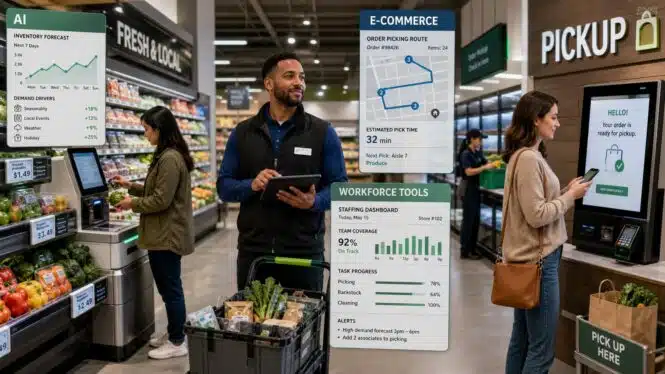
Nice article this month from Progressive Grocery on Tech Trends Study
The study’s core message is that grocery technology spending remains resilient in 2026, but retailers are directing it toward owned digital experiences, operational productivity, loyalty, pricing agility, and practical AI rather than flashy hardware experiments. The survey of 70 grocery retailers shows AI moving from pilots into planned deployment, while talent, implementation capacity, and the pace of change remain the main constraints.
The article is useful as a narrow survey of near-term grocery IT priorities, but it treats “grocery technology” largely as e-commerce, loyalty, store systems, self-checkout, ESLs, analytics, and AI. It barely recognizes the grocery site as a public-facing, multimodal physical environment. What they missed we cover in addendum.
Key findings
-
Technology budgets are holding or growing.
96% of respondents expect technology and automation investment to stay level or rise in 2026; 60% expect an increase. This suggests technology has become a core operating investment rather than a discretionary innovation budget. -
Retailers want control of their digital customer relationship.
60% say it is very or extremely important to control the e-commerce experience themselves, up from 45% in 2025. The implication is less reliance on third-party marketplaces and delivery platforms, and more interest in owning customer data, branding, promotions, loyalty integration, and omnichannel economics. -
E-commerce and AI are the leading expected growth drivers.
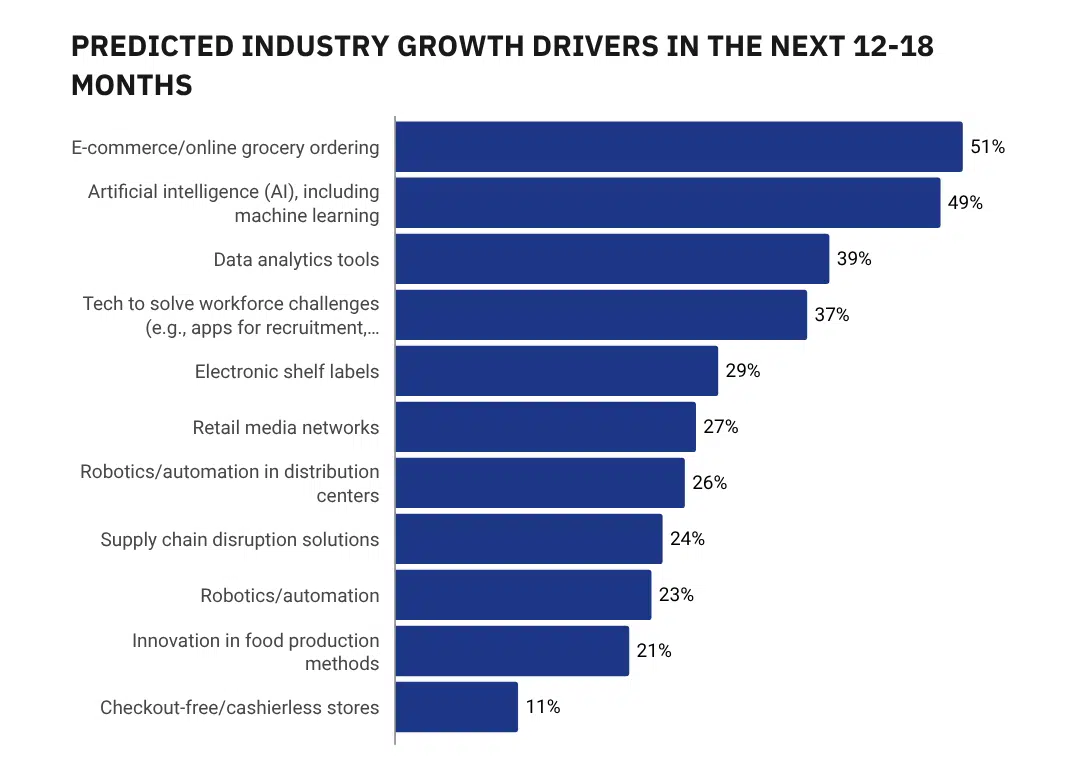
51% identify e-commerce/online grocery ordering as a major growth driver for the next 12–18 months; 49% say the same for AI and machine learning. -
Delivery speed is becoming a competitive expectation.
57% see delivery in 30 minutes or less as a principal e-commerce growth driver, slightly ahead of standard delivery at 51%. That points to convenience and fulfillment execution—not merely having online ordering—as a differentiator.
Customer Facing Technologies and Workforce Facing
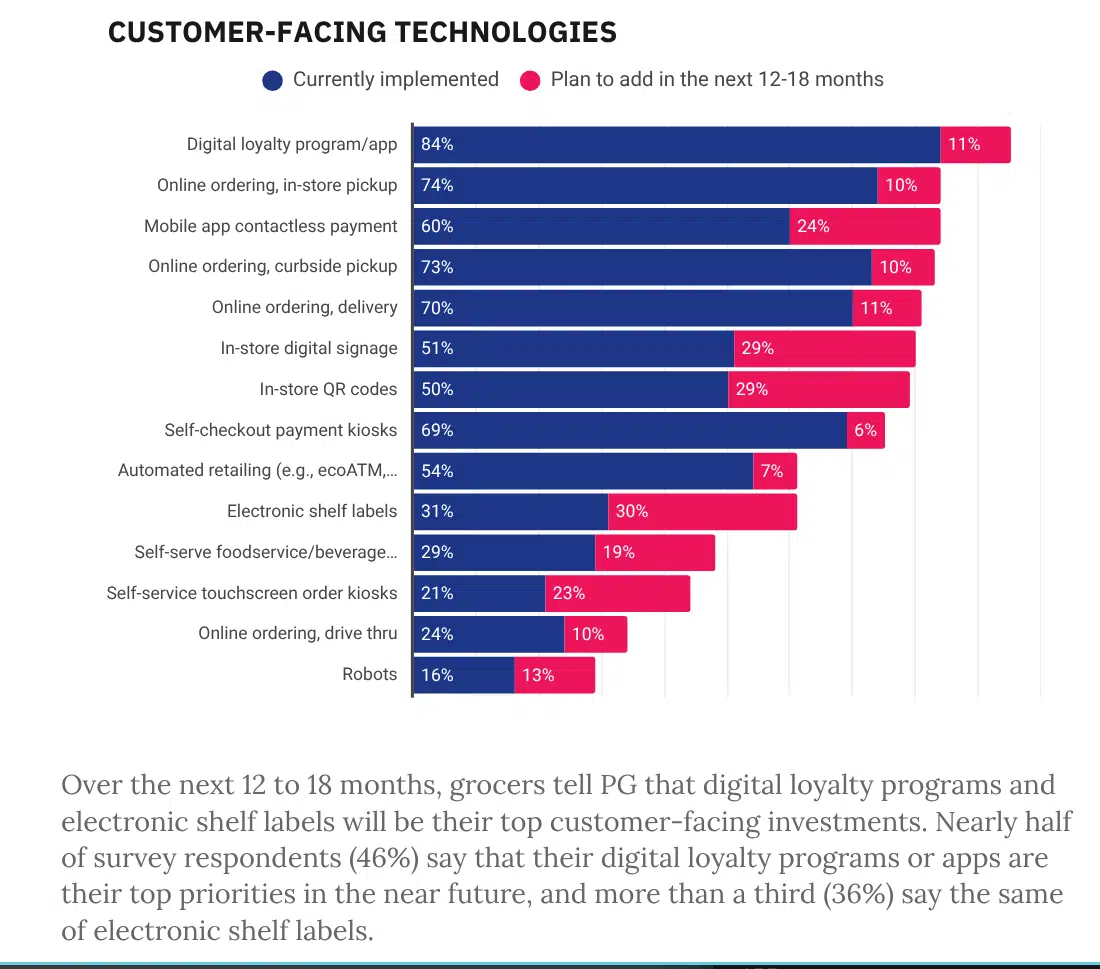
Biggest priority for grocers has Workforce #4 behind E-Commerce, AI and Analytics. Sounds right. Below Workforce comes ESL and other customer facing technologies
grocery technology
Physical-store technology priorities
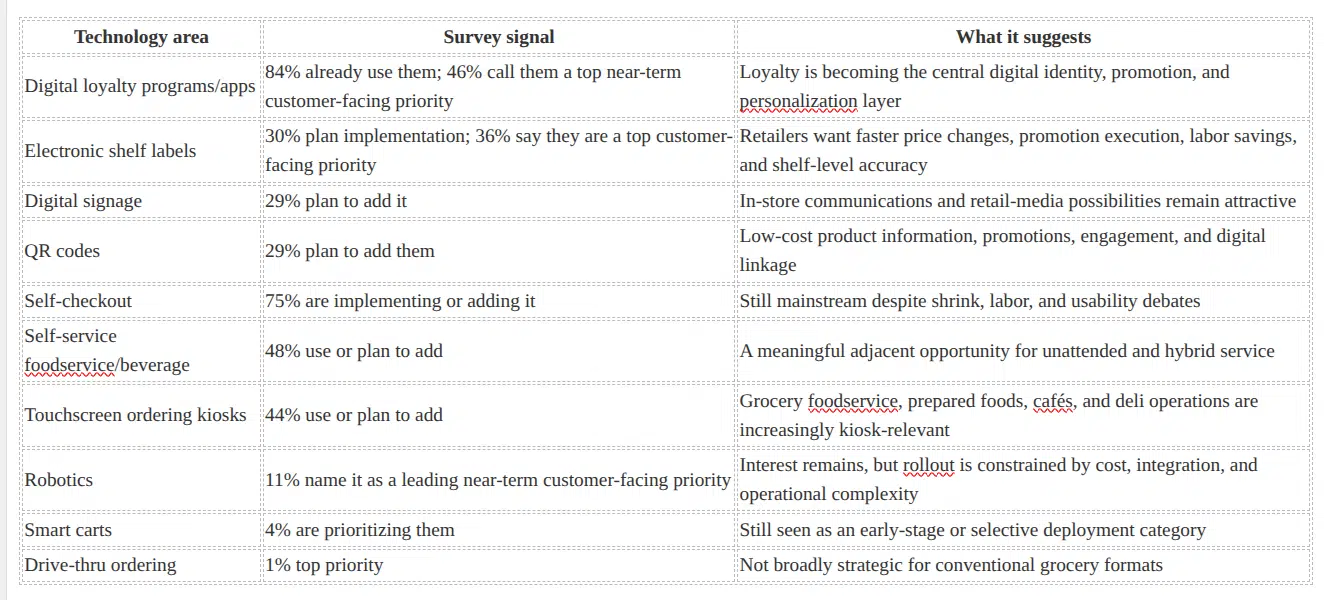
The survey depicts a pragmatic store-modernization agenda: improve the shopper experience, make pricing and promotions more dynamic, and deploy self-service where the economics are proven.
grocery tech trends
For the kiosk and self-service market, the important signal is that grocery’s opportunity is not primarily broad-front-end automation. It is more likely to emerge in contained, high-value journeys: prepared food ordering, beverage stations, deli, meal solutions, loyalty-linked self-service, and digitally assisted service points.
Shopper experience is shifting
Retailers still believe consumers value digital deals, but the emphasis is broadening beyond discounts alone:
-
59% think customers will value digital discounts and promotions most over the next 12–18 months, down from 71% in 2025.
-
54% expect shoppers to value a hybrid experience that combines technology with in-store staff.
-
27% expect interest in interactive online capabilities—such as shoppable video and livestreaming—to matter, a notable increase from the prior year.
That is a useful caution against a “technology replaces people” narrative. Grocery operators increasingly appear to view technology as a way to make staff more effective, reduce friction, and personalize the experience—not simply remove labor from the store.
AI is moving into deployment
AI is no longer just a strategy-slide topic in the survey. Adoption remains relatively low, but the pipeline is substantial:
-
73% have implemented AI/ML solutions or plan to do so within 12–18 months.
-
29% have already implemented AI/ML; 44% plan additions soon.
-
80% have deployed, plan to deploy, or are investigating AI-powered employee tools.
-
Employee AI tools: 17% already deployed, 39% planning near-term implementation.
-
Customer-facing AI tools: 13% already deployed, 39% planning near-term implementation.
-
AI-powered employee tools are the leading priority among technologies already implemented or planned, cited by 31%.
The distinction matters: the strongest near-term AI use case is likely behind the scenes and employee-facing—analytics, reporting, workforce enablement, inventory and out-of-stock management, merchandising, and workflow support—before widespread consumer-facing AI experiences become standard.
The respondents who named additional technologies mentioned agentic AI, AI merchandising, and AI-driven site selection. Those are early signs that operators are looking beyond chatbots toward decision support and semi-automated operational workflows.
Operational implications
The report suggests grocers are trying to modernize the store without losing the human element:
-
51% are more focused on in-store back-end technology than warehouse/distribution technology; 29% lean more toward warehouse/DC investments.
-
Investment is nearly evenly split between customer-facing technology, 41%, and back-end operational technology, 39%.
-
Training/retention technology and analytics/reporting platforms are the leading back-end priorities, each selected by 34%.
-
AI/ML follows at 31%.
-
84% believe technology solutions are available to address out-of-stocks.
In plain terms, the practical grocery-tech stack is becoming: loyalty + digital commerce + shelf/pricing tools + analytics + employee enablement + selective self-service.
Barriers and caution flags
The study is optimistic about investment, but not complacent:
-
53% say their company is only somewhat successful at keeping pace with technology change.
-
Only 36% rate themselves successful or very successful in keeping up.
-
74% believe frontline employees can be trained to succeed in a digital grocery environment.
-
But only 66% believe they have the technical talent needed for the future.
The main bottleneck is therefore less about whether technology exists and more about whether retailers can select, integrate, govern, staff, and scale it. That is especially relevant for AI, ESLs, digital shelves, kiosk platforms, retail media, and omnichannel systems, where integration into pricing, promotions, POS, inventory, loyalty, and workforce workflows determines the actual return.
Bottom line
The 2026 grocery technology story is incremental digital transformation at scale, not a wholesale leap into autonomous stores or robotics. Retailers are prioritizing technologies that:
-
Strengthen their owned customer ecosystem.
-
Improve loyalty, promotions, and personalization.
-
Speed up digital fulfillment and delivery.
-
Improve store execution, pricing agility, and out-of-stock performance.
-
Support employees with data and AI.
-
Add self-service in defined operationally viable settings.
For an industry observer, the clearest takeaway is that the market is favoring technologies with measurable operational value and a credible path to integration. Electronic shelf labels, digital loyalty, employee AI, analytics, foodservice self-service, and kiosk-enabled ordering look better aligned with grocery’s current buying priorities than robots, smart carts, or other capital-intensive experimental concepts.
Addendum – What PG Missed…
What the study leaves out
The omissions are notable because the survey explicitly discusses physical-store modernization and customer-facing technology, yet does not address:
-
EV charging as a store-visit, parking-lot, dwell-time, loyalty, and retail-media opportunity.
-
Accessibility as a product, interface, physical-environment, procurement, and regulatory design requirement.
-
Regulatory exposure, including ADA obligations, state/local accessibility rules, privacy, AI governance, consumer protection, payments, pricing disclosure, and emerging self-service device standards.
-
Outdoor technology: curbside pickup, pickup lockers, drive-up service, parking guidance, smart carts/returns, digital wayfinding, EV charging, security/intercoms, outdoor digital signage, and weatherized self-service.
-
Site infrastructure, such as electrical capacity, network connectivity, parking design, lighting, routing, accessibility paths, and maintenance/service models.
That is particularly striking given that the article itself cites self-checkout, self-service foodservice machines, touch-screen ordering kiosks, QR codes, and digital shelves. Each has user-interface, reach-range, operable-parts, communications, and physical-access implications—not just ROI and deployment considerations. The Progressive Grocer study is explicitly positioned around what retailers are investing in and how they modernize physical stores, but its framework seems to stop at the store entrance.progressivegrocer
EV charging is not peripheral
EV charging belongs in a grocery-tech discussion for more than sustainability optics. Grocery is a highly attractive retail amenity for public charging: a 2026 Transportation Energy Institute analysis of more than 4,000 public fast-charging stations found sites near grocery stores averaged 42 charging sessions per day—nearly five times the dataset median of 9—while only 6.7% of the analyzed stations were near grocery stores. That suggests a material whitespace opportunity, especially where a 20–45 minute grocery trip maps well to charging dwell time.convenience+1
For grocers, a serious EV program connects to:
-
Store traffic, visit frequency, and dwell time.
-
Loyalty identity and targeted offers while a customer charges.
-
Parking-lot digital infrastructure and site-energy planning.
-
Foodservice, pickup, pharmacy, and convenience add-on sales.
-
Retail media and on-screen communications, where appropriate.
-
Property-owner, utility, charging-network, and payment relationships.
It is not necessarily a universal deployment case—site power, capital cost, lease structure, utilization, curb layout, and maintenance can change the economics—but it should at least be a strategic category in a broad “grocery tech trends” survey.
Accessibility should be foundational
The article’s “hybrid experience” observation is actually an argument for accessibility, even though it never uses the term. It reports that 54% of respondents expect customers to value a blend of technology and in-store staff. That is exactly the right outcome: self-service must not become an inaccessible or unsupported service model; assistance needs to be available, equivalent, and workable in real store conditions.
The U.S. Access Board states that entities subject to the ADA or ABA must make EV charging stations accessible and usable by people with disabilities. Its design guidance covers accessible routes, charging-space geometry, access aisles, ground conditions, operable parts, communication features, and reach/operation requirements. The Alternative Fuels Data Center similarly notes that accessible chargers require adequate vehicle and maneuvering space, unobstructed access, suitable paths to the building, and appropriate signage; federal ICT-related deployments can also invoke Section 508 requirements.access-board+1
Those same design disciplines carry into grocery technology:
In other words, accessibility cannot be reduced to a late compliance review. It is a systems-design requirement spanning the physical site, software, hardware, operations, procurement specifications, and human fallback.
Outdoor retail is a missing layer
The study’s focus on “in-store” versus warehouse/DC technology leaves out the increasingly important space between the street and the entrance. That outdoor layer now includes the parking lot, curb, fueling/charging areas, pickup zones, entry vestibules, sidewalks, and often mixed-use foodservice or pharmacy service points.
A more complete grocery-tech model would include:
-
EV chargers with accessible, safe pedestrian routing.
-
Curbside pickup check-in, queuing, customer notification, and staff workflow tools.
-
Pickup lockers or temperature-controlled food lockers.
-
Outdoor-rated ordering, payment, intercom, and wayfinding systems.
-
Parking management, occupancy sensing, license-plate policy considerations, and delivery-driver zones.
-
Security, lighting, emergency communications, and weather resilience.
-
Digital signage that supports—not replaces—clear accessible wayfinding.
-
Integration with loyalty, order management, payments, customer service, and store operations.
This is where many deployments fail in practice. An indoor experience can be polished while the customer still encounters an inaccessible curb, an unclear pickup process, no weather protection, poor lighting, a noncompliant charger, unreliable wireless coverage, or no way to obtain help.
Why Progressive Grocer may have missed it
The likely explanation is methodological rather than deliberate: the survey asked retailers about a pre-defined menu of technology categories, and the reported results concentrate on the selected list—loyalty, e-commerce, AI, digital shelves, smart labeling, self-checkout, foodservice self-service, kiosks, robotics, and related tools. It appears to be an enterprise-retail technology survey, not a full-site infrastructure, regulatory-readiness, or inclusive-design study.progressivegrocer+1
That scope is understandable, but it produces a distorted picture if presented as the overall grocery-tech agenda. The result is a familiar retail-technology framing:
Digital commerce + AI + labor productivity + store experience
A stronger 2026 framing would be:
Digital commerce + AI + workforce enablement + accessible physical retail infrastructure + outdoor/parking-lot services + regulatory readiness
Editorial takeaway
Grocery’s next technology frontier is not simply “more digital inside the store.” It is the connected accessible retail site: an omnichannel environment extending from online ordering and workforce tools to parking, pickup, charging, signage, self-service, and human assistance.
That framing would give readers a much better way to evaluate technology investments:
-
Does it improve a shopper or associate workflow?
-
Does it integrate with the owned commerce, loyalty, POS, inventory, and service stack?
-
Is it usable by people with disabilities in actual operating conditions?
-
Does it work outdoors, in bad weather, at the curb, and in the parking lot?
-
Does the deployment create regulatory, safety, privacy, or maintenance exposure?
-
Does it increase—not fragment—the value of the physical grocery site?
The Progressive Grocer survey captures the first two questions well. It largely leaves the other four unanswered.


